For organizations·Offer it as a benefit

Pathology Bill After a Biopsy: What to Verify Before Paying

Content authorBy mediloopPublished onReading time10 min read
A young couple sits closely at a wooden kitchen table, reviewing bills and documents in warm, natural daylight.

This article explains how to check a pathology statement that arrives after an office biopsy as you use the specimen record and the pathology report. It gives you a worksheet for matching each charge to documented work, plus a written request you can send when a line item doesn't make sense.

The statement from a lab you never visited

A pathology statement arrives weeks after the biopsy, from a laboratory you never visited, and whether you're insured or facing a hospital bill without insurance, the first question is the same: what is this charge for? The envelope carries a name that wasn't on your appointment confirmation. Nothing on it explains why a separate company is asking you for money.

That confusion is normal, and it's structural. A biopsy routinely involves more than one organization, and each one bills for its own part. Verifying the statement means lining up what you were charged against what the records say happened to your tissue. You're doing administrative matching here.

Why pathology bills separately

Your clinician removed the tissue. Someone else turned it into slides, and a pathologist read those slides and wrote a report. When those steps happen inside different organizations, each organization sends its own statement, which is why a bill shows up under a name you don't recognize.

Rohit Chopra, then Director of the Consumer Financial Protection Bureau, described the pattern plainly in 2022: "Many procedures include separate bills from providers and facilities." Pathology is one of the clearest examples. PathGroup, which operates as Associated Pathologists, LLC out of Brentwood, Tennessee, is an independent anatomic pathology group serving clinics across several states, so a dermatology office in one town can send tissue to a lab registered in another and you receive paper from both.

The split also has a rule behind it. Since July 1, 2012, Medicare has allowed only the hospital to bill for the technical component of a physician pathology service furnished to its inpatients or outpatients. Where the biopsy happened changes who sends the statement, and that's worth knowing before you assume someone billed you twice.

What each party did

Three distinct pieces of work sit behind most biopsy charges. Tissue collection is the procedure in the exam room. Laboratory preparation is everything that turns a specimen into a readable slide, which Medicare's billing manual groups under the revenue code 0314, PATHOL/BIOPSY. Professional interpretation is the pathologist examining that slide and signing a report.

Separate charges for separate work aren't duplicates. The test is whether each charge points to documented work by a named party on a named specimen. For scale, when CMS valued the common surgical pathology code 88305 in its 2009 physician fee schedule notice, it listed a total nonfacility rate of $102.83 per specimen examined, which shows how quickly line items multiply when several specimens travel together.

This distinction matters for anyone sorting out a hospital bill without insurance, because a self-pay balance combines facility and professional work on one page with wording that hides the difference. Ask which party performed which step. The answer resolves half the confusion.

Build your biopsy worksheet

Put everything on one sheet before you call anyone. The point is comparison, and a filled-in grid tells you precisely which question to ask and who to ask it of. Keep a column for payments and any adjustment applied through a hospital financial assistance program, since those change the balance without changing the charges.

What you're matchingWhere it comes fromWhat to write down
The procedureVisit summary or portal noteDate, clinician, site sampled
The specimenPathology report headerSpecimen label, accession number
The chargePathology statement or itemized hospital billDescription, code, units, date, balance
The coverageExplanation of benefitsClaim number, allowed amount, your share
The unanswered partYour own notesThe exact question and who owes you an answer

Any row you can't complete is a question. Write it down and move on.

Before you pay it

Upload the bill to a free mediloop account. An automatic first look shows what looks worth questioning, usually in about a minute.

Check my bill for free →

Record the biopsy details

Start with the facts that identify the episode, because every later comparison depends on them. Pathology laboratories accession each specimen into their information system and reference that number in the report, which gives you a reliable anchor.

  • Biopsy date and the clinician who performed it

  • Laboratory name and the pathologist who signed the report

  • Specimen labels (often A, B, C) and the accession number

Match report to charges

Now connect the two documents. For every specimen listed in the report, find the line on the statement that corresponds to it and note the billed description and the number of units.

Units are where most questions start. A Health and Human Services Office of Inspector General audit of urology pathology services described the rule simply: each tissue examination is billed as one unit of service. Two specimens and two units line up. Two units against one specimen is something to ask about.

Add the EOB

If you have coverage, pull the explanation of benefits (EOB) for the same date and record the allowed amount and the patient responsibility. CMS is direct about what that document is: an explanation of benefits isn't a bill. It shows how much your plan covers and what you'll owe once the provider bills you.

Compare the two numbers. CMS also advises that your bill shouldn't be higher than the patient responsibility on the EOB, and if it is, that's a conversation with the provider. Someone resolving a hospital bill without insurance skips this step entirely and substitutes the documents described further down.

Review the itemized hospital bill

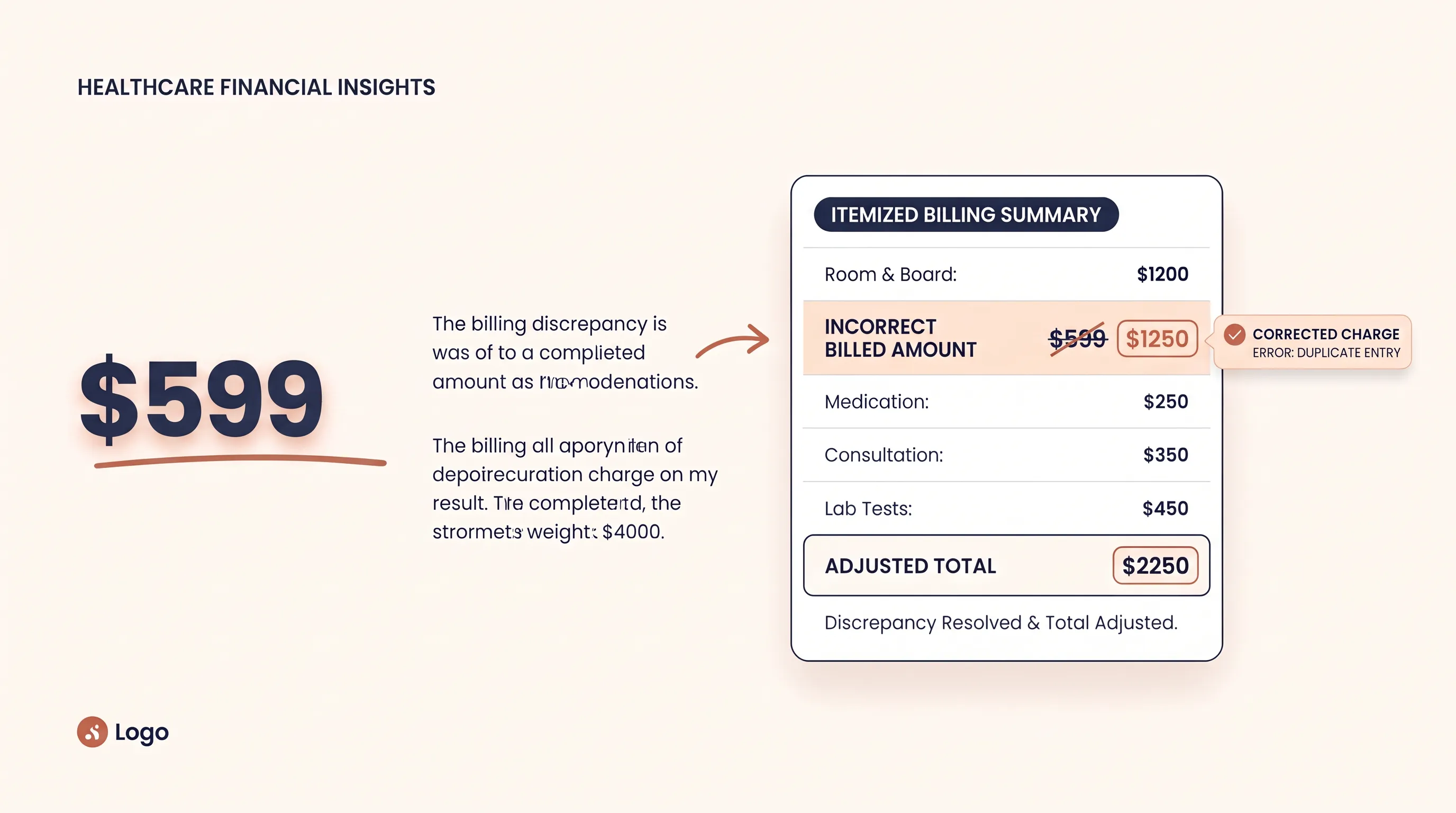
Minimalist infographic showing a financial discrepancy with bold "$599" figure, warm off-white background, and structured summary card.

If the biopsy happened in a hospital outpatient department, a second statement exists. Request the itemized hospital bill and set it beside the pathology statement so you can match dates and specimen references.

Similar language doesn't prove the same service. One document can describe the facility's slide preparation while the other describes the pathologist's reading, and both will say "pathology." Check whether the itemized hospital bill already reflects payments or a write-off from a hospital financial assistance program before you treat the bottom line as what you owe on a hospital bill without insurance.

Explain multiple charges

Multiple lines have ordinary explanations. If your clinician took tissue from two sites and submitted them in separately labeled containers, that's two specimens and two interpretations. The National Correct Coding Initiative manual states the converse too: if only one specimen is submitted for surgical pathology, only one surgical pathology code may be reported, even when the report covers more than one feature of it.

Documented additional laboratory work also produces additional lines. Special stains and immunohistochemistry are separate procedures with their own codes, and they appear in the pathology report when they were performed. So the question is whether the report supports it.

None of this tells you a charge is wrong. The CFPB has said medical billing is "riddled with errors", which include duplicative charges and services never received, and about 100 million Americans owe more than $220 billion in medical debt. That's a reason to ask. Checking a hospital bill without insurance works the same way, since an unexplained line is unexplained until someone explains it.

Before you pay it

Upload the bill to a free mediloop account. An automatic first look shows what looks worth questioning, usually in about a minute.

Check my bill for free →

Request the right records

You're asking for documents that already exist. Under the HIPAA Privacy Rule, a covered entity must act on an access request within 30 days, with one 30-day extension possible. Laboratories get the same clock, and HHS has addressed the case where 60 calendar days still isn't enough to complete a test report.

  • From the clinician: the pathology report and the specimen or accession details for that date

  • From the laboratory: the full billing statement with codes, units, and dates

  • From the insurer: the processed claim and the matching EOB

Ask the hospital for the itemized hospital bill at the same time, and ask whether its hospital financial assistance program applies to the balance of a hospital bill without insurance. You're requesting records of work already done, so nothing here involves ordering a new test or asking anyone to interpret your results again.

Hospital bill without insurance

Without an EOB, the worksheet still works. You replace the insurance row with the documents a self-pay patient actually has. Any good faith estimate goes in first, because providers must give uninsured or self-pay individuals an estimate of expected charges, and a hospital bill without insurance that exceeds that estimate by $400 or more qualifies for patient-provider dispute resolution. Convening providers must also supply a copy of any estimate issued in the last 6 years on request.

Then add your receipts and any self-pay discount already applied. Ask the billing entity for a detailed statement in writing. A hospital bill without insurance frequently lands at full chargemaster rates that no insurer would ever pay, which is exactly why the detail matters.

Assistance is a parallel track. Section 501(r)(4) of the Internal Revenue Code requires every tax-exempt hospital facility to maintain a written financial assistance policy and publicize it, so a hospital financial assistance program exists at nonprofit hospitals whether or not anyone mentioned it to you. Before extraordinary collection actions, those facilities must also make reasonable efforts to determine eligibility, which include at least 120 days after the first billing statement. Independent pathology groups set their own policies, so ask each biller separately whether a hospital financial assistance program or discount applies.

Not sure whether any of this applies to the statement in front of you? Get a free first look at the charges. Upload a photo or PDF, then verify your email to receive it.

Ask for an explanation

Put the request in writing and keep it narrow. Reference the account number and the date of service, and ask which specimen each charge concerns and what documented work supports every billed unit. Ask who performed that work and how the current balance was calculated from the allowed amount or the self-pay rate.

Close by asking for a written response or a corrected statement, and request that the account be noted as under review while they answer. Attach nothing clinical. You can use wording like this:

  1. "Please identify the specimen and accession number associated with each billed line."

  2. "Please describe the documented work supporting each unit billed, and name the party that performed it."

  3. "Please show how the balance was calculated with any adjustment or discount applied."

  4. "Please respond in writing, or send a corrected itemized hospital bill, and hold the account while this is reviewed."

Send the same letter to each biller involved. If the hospital responds and the laboratory doesn't, you still know which half of the hospital bill without insurance remains unverified, and you can escalate that one. Ask again about a hospital financial assistance program in the same message so both questions move together.

Before you pay

A pathology statement becomes readable once each charge is tied to a specimen and a document. You're matching paperwork, and the records you need already exist. Ask for them in writing, then decide.

If the answers don't add up, mediloop can take it from there. Our software reads your uploaded bill and flags what looks questionable, and a human advocate reviews the case and handles the provider conversations. Check my bill at mediloop for a free first look, whether it's a pathology statement or a hospital bill without insurance.

Before you pay it

Upload the bill to a free mediloop account. An automatic first look shows what looks worth questioning, usually in about a minute.

Check my bill for free →

The laboratory may have processed and prepared your tissue after the clinician collected it. Pathology work often occurs in a separate organization, so the laboratory can bill independently from the clinic or hospital. Match its name, date, specimen label, and accession number to your pathology report before assuming the statement is incorrect.

Compare each billed line with the specimen labels and accession number on the pathology report. Record the code, units, date, and description, then check whether the report documents the related examination or added testing. A mismatch, such as two units for one submitted specimen, deserves a written explanation from the billing party.

If you have no EOB, compare the hospital bill with your good faith estimate, receipts, self-pay discount, and payment history. Ask for a detailed statement that identifies each service and adjustment. A hospital bill without insurance that exceeds the estimate by at least $400 can qualify for the federal patient-provider dispute process.

Yes. Request the complete statement, billing codes, units, service dates, and account details from the laboratory. You can also request the pathology report and specimen information from the clinician, then ask your insurer for the processed claim if you had coverage. Under HIPAA, a covered entity generally must respond within 30 days, with one possible extension.

Dispute a charge when the statement lacks a matching specimen, lists unsupported units, repeats work documented elsewhere, or calculates a balance incorrectly. Send a focused written request that names the account and service date, asks who performed each billed service, and requests a corrected statement. Mediloop can help flag questionable bill lines for review.

Not sure what applies to your bill? Check it for free.

Make a free mediloop account and upload the bill. An automatic first look reads the charges and shows what looks worth questioning, usually in about a minute.