Confirm coverage before sharing documents
Confirm four things before you upload a single page. Start with who qualifies and which bills the service takes. Then confirm what it will actually do and where your documents land. Ten minutes of questions prevents the common outcome, which is sending a full file to a vendor that then tells you your bill is out of scope.
Scope limits are rarely advertised on the landing page. They live in the intake rules and the eligibility criteria, along with the fine print about case counts. You'll get them by asking a human.
Work through the four questions below in order. Each one can disqualify your situation on its own, so there's no sense answering the third before the first. And if the service won't answer any of them before intake, that reluctance is your answer about how the rest of the case will go.
Who can use the service?
Ask whether the benefit extends to your spouse or partner and to dependents. Ask the same about retirees and other household members, and whether eligibility depends on being enrolled in a specific health plan. Household coverage is common but never automatic.
Some programs are genuinely broad. In a case documented by the US Surgeon General's workplace framework, Kennesaw State University made its EAP, which includes financial and legal support, available to all staff and to household members, as well as to dependents.
Dependent eligibility is where households lose access without realizing it. A bill in your adult child's name, for care they received while on your plan, sits in exactly the gap most programs define narrowly. Ask about that specific case rather than about dependents in general.
Which bills are accepted?
Ask for the acceptance criteria before you describe your bill. The ones that matter:
-
Provider types, minimum balance, and service dates
-
Denied claims, uninsured bills, accounts already in collections
Also confirm whether one hospital stay that generated four separate bills counts as one case or four, because that single answer can exhaust an annual case limit. Timing matters too. CMS notes you should receive an explanation of benefits from your plan before the provider's bill arrives, and that the two documents are not the same thing.
Which gives you a sequencing rule nobody states outright: if the EOB hasn't landed yet, the claim is still moving, and a vendor working from the bill alone is working from half the picture.
What will the service do?
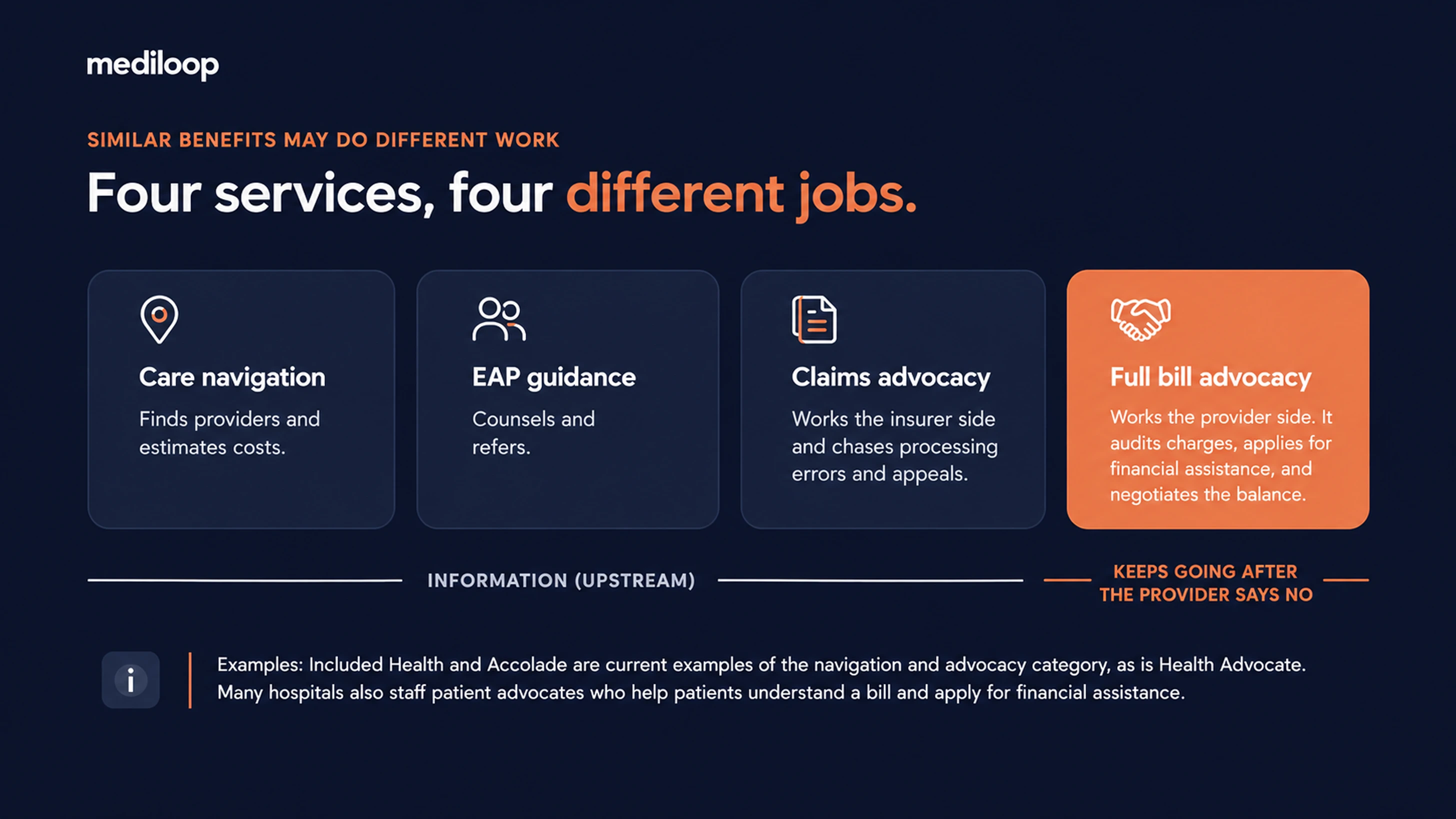
Get the verb list. Does it audit line-item charges and check procedure codes? Does it appeal denied claims and apply for hospital financial assistance? Does it negotiate the balance and speak to the provider directly on your behalf? Ask which of those it has done in cases like yours.
Asking works more often than people expect. In a nationally representative survey published in JAMA Health Forum in 2024, Erin Duffy and colleagues found that among adults who contacted the billing office about a bill they disputed or couldn't afford, 25.7% had the bill corrected and 15.2% received a price reduction, while 8.1% got financial assistance.
Those three outcomes come from three different routes, and a service that only does one of them leaves the other two on the table. So ask about fees and any charge calculated as a percentage of savings. Ask about case limits per year and what authorization you'll need to sign.
How is privacy protected?
Upload through the vendor's own secure intake. Not email and not a shared drive. Not HR's inbox. Confirm in advance who receives your bills and your EOBs. Confirm who receives your signed authorization and your case updates, and whether anyone at your employer sees case-level detail.
Authorization is the mechanism that lets someone else act for you. The Department of Labor has stated that a plan's procedures for designating an authorized representative cannot prevent claimants from choosing who represents them, for the initial claim or an appeal.
Read the authorization you're signing as a scope document. It defines exactly which organizations the service can contact and what it can discuss. If it's written broadly enough to cover people you didn't intend, that's worth catching before you sign rather than after.
Send a benefit-only information request
Send one short message that asks about the benefit and shares nothing clinical. Copy this and adjust the names:
-
"I'm asking about benefits only and I'm not submitting any medical records, bills, or treatment details with this message."
-
"Do we have a vendor that reviews medical bills and contacts providers on a member's behalf? If so, please send the vendor name, who's eligible in a household, what the service covers, any cost to me, and the direct intake link or phone number."
Keeping bills out of that message isn't excessive caution. CMS is explicit that an explanation of benefits isn't a bill, and both documents carry service descriptions and dates that reveal your care.
Then take the one step that matters: contact the vendor directly, through their intake, with your own authorization. Your employer's role ends at handing you the link.
Get bill advocacy when benefits fall short
If none of those five channels produces a service that will work your bill, mediloop is an independent option you can use on your own. You upload the bill and the EOB. AI-powered investigation reads the documents and pulls out every charge, then runs the checks and drafts the review. A human advocate reviews the case and prepares the plan, then handles the supported provider conversations. Only people make those calls.
Pricing is flat. Pay Per Bill is $129 upfront for one supported bill, and if we don't lower that bill by at least $129, the $129 is refunded in full. The Annual Plan is $499 a year for up to six household bills, refunded in full if the handled bills aren't lowered by at least $499 combined. Refunds go out the day the case closes, subject to current Terms eligibility and exclusions.
Start by uploading a photo or PDF for a free first look: Check my bill.