What should you ask provider billing?
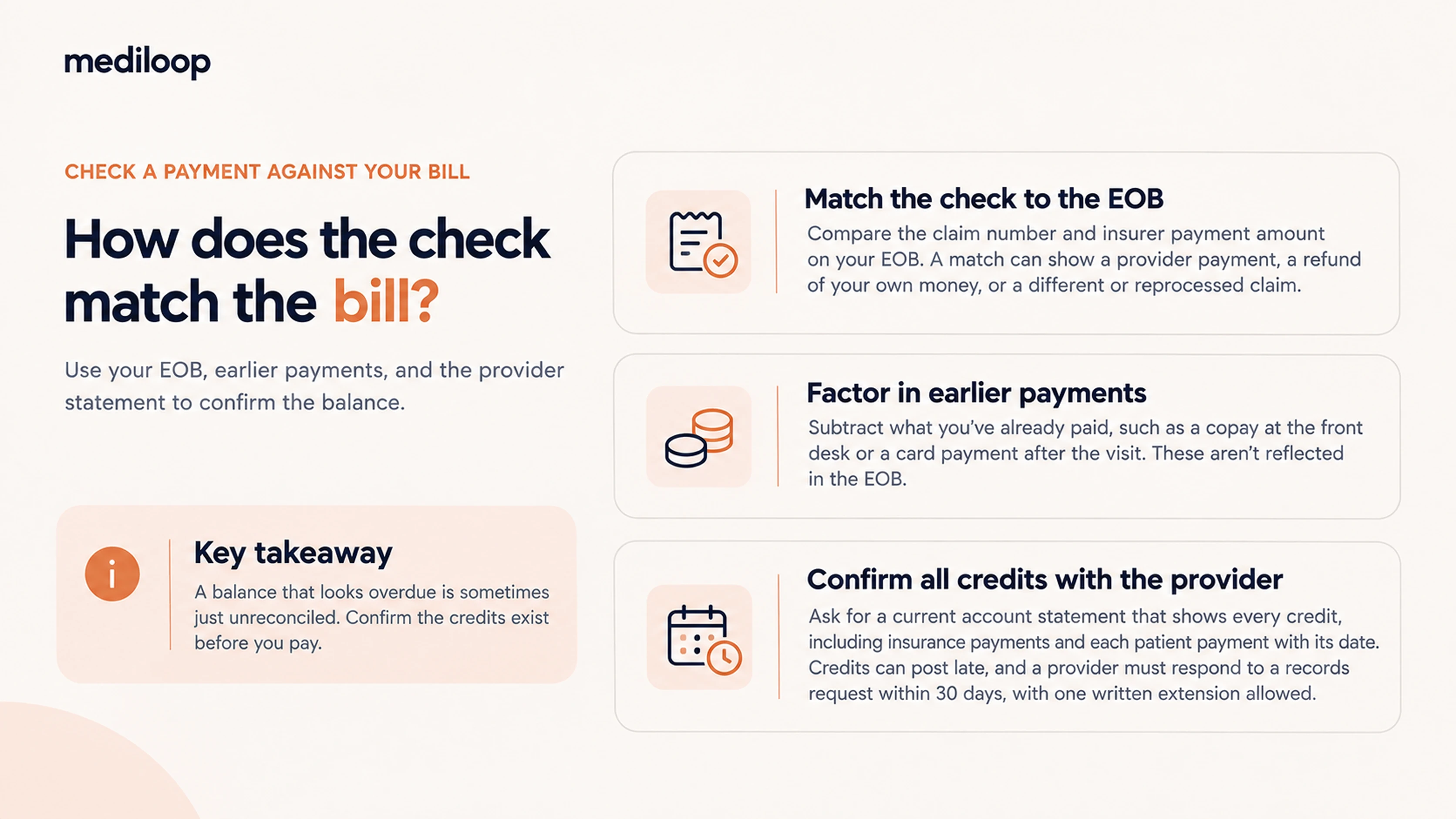
Ask whether a payment for that claim is already pending or posted, and how a confirmed payment should be credited to your account. Billing offices receive an electronic remittance for the same claim, which means the paper check in your hand is a duplicate or a correction.
Then request an updated statement showing all insurance adjustments and the resulting balance. A mediloop guide to reconciling bill and EOB amounts suggests asking for patient financial services rather than the general billing line, since that team has authority the first-tier queue doesn't.
Ask one more thing while you have them: whether the account can be held while the payment is traced. A hold you requested and confirmed in writing is worth far more than a verbal assurance that nothing bad will happen.
How should you track the open balance?
Track the bill's actual due date. Write down each contact with a date and a name, and every written instruction you received.
Deadlines keep running while you reconcile. Nonprofit hospitals operate under Section 501(r)(6) of the tax code, which requires reasonable efforts to check financial assistance eligibility before extraordinary collection actions and sets a 120-day notification period starting from the first post-discharge billing statement, with a 240-day application window.
That 120-day clock is a floor for certain actions at certain hospitals. Which is why a verbal "we'll note the account" shouldn't be mistaken for a hold. Ask for the hold explicitly and ask for it in the portal or by email so you have something to point to.
When is the issue fully resolved?
The issue is resolved when the payment has been handled according to written instructions and the provider's account reflects the result. Two confirmations close it: the insurer stating what the payment was and how it was applied, and a revised provider statement showing the credit and the remaining balance.
This is worth finishing properly. The Consumer Financial Protection Bureau found that 15 million Americans still had medical bills on their credit reports that totaled more than $49 billion in collections, even after the national credit bureaus changed their reporting rules.
An unreconciled payment is one of the quieter ways a balance drifts toward that outcome, because nobody involved thinks the account is their problem. Keep the revised statement and the insurer's written confirmation together in one file. If the balance resurfaces later, that file is your entire argument.
Need help reconciling the remaining bill?
If the documents still conflict after both calls, mediloop can review the bill and the EOB for errors and support eligible follow-up with your provider. The review is AI-powered investigation with a human advocate on every case: the system reads your uploaded documents and drafts the findings, then an advocate reviews the case and handles supported provider conversations. Only people contact providers and negotiate.
To be clear about one thing: mediloop advocates on the billing issue and never receives or deposits checks. You handle that part with your insurer and your provider.
Pay Per Bill is a flat $129 upfront for one supported bill, never a percentage of savings, and if we don't lower the bill by at least $129, the $129 is refunded in full. The Annual Plan is $499 per year for up to six household bills, refunded in full if handled bills aren't lowered by at least $499 combined. Refunds go out the day the case closes, subject to current Terms eligibility and exclusions.
Start with a free first look. Upload a photo or PDF of the bill at my.mediloop.ai, then add your name and email to verify access.