For organizations·Offer it as a benefit

PET Scan Cost in the U.S.: Scan, Tracer and Radiologist Fees

Content authorBy mediloopPublished onReading time10 min read
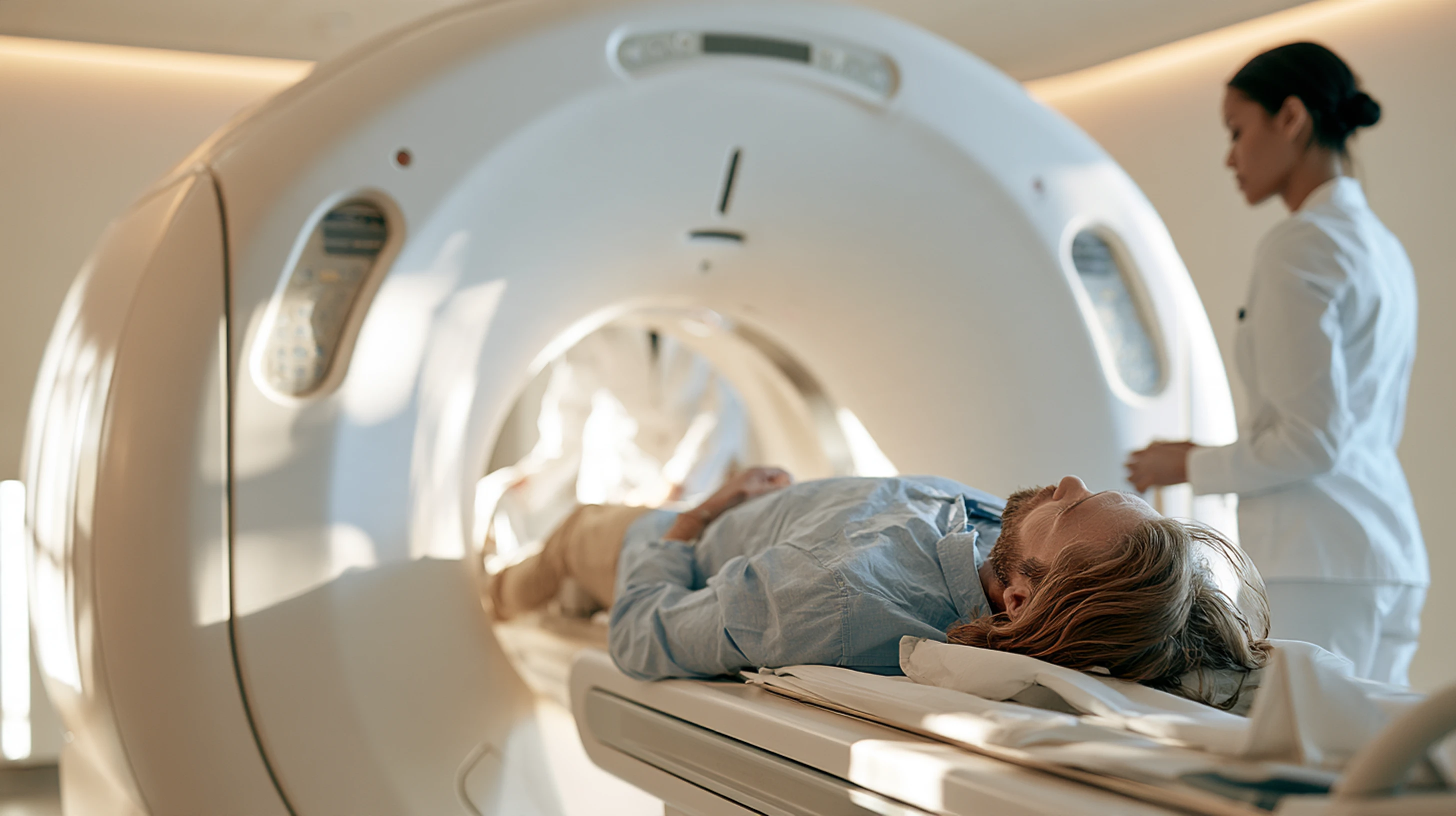
Patient lying on a medical imaging scanner table while a healthcare technician prepares the examination in a modern diagnostic imaging center

This article explains how pet scan cost is set for a PET or PET-CT exam in the United States, piece by piece, so you can compare quotes that actually describe the same study. It covers the four charges that make up the total and how to compare cash and insurance figures.

Confirm the prescribed exam

The pet scan cost you're quoted only means something once you know which exam it covers. Two facilities can quote figures a thousand dollars apart and be describing different studies or different tracers.

So start with the order itself. Ask the ordering office for the exact protocol and the radiopharmaceutical named. Confirm the body area to be imaged and whether a computed tomography (CT) component is included. Ask for the location where the scan will happen. Write all of it down before you call anyone about price.

A fluorodeoxyglucose (FDG) tumor study and a prostate-specific membrane antigen (PSMA) study are not interchangeable, and neither are a limited-area scan and a skull-base-to-mid-thigh scan. Comparing their prices tells you nothing useful.

What determines pet scan cost

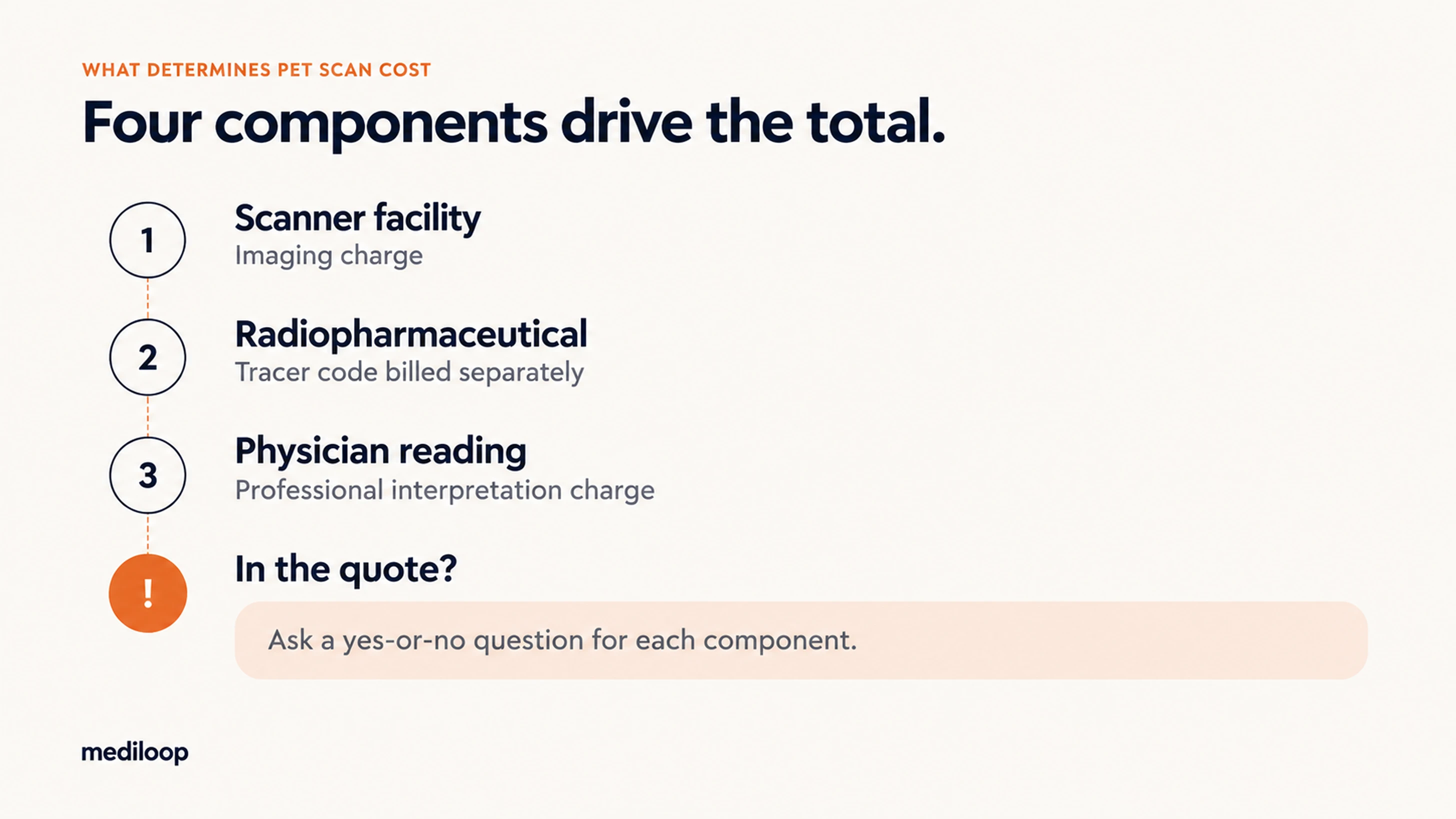
Infographic explaining the four main components of PET scan costs, including scanner facility fees, radiopharmaceutical tracers, physician interpretation, and quote verification

One PET appointment can produce charges from more than one biller. The scanner facility bills for the imaging. The radiopharmaceutical is coded separately. The physician who reads the images bills separately again, sometimes from a group with a different name and a different address.

Medicare's claims rules make this structure plain: every PET service requires a radiopharmaceutical, and the applicable tracer code must be billed alongside the scan code. Commercial and cash pricing follows the same anatomy. That's why a single number quoted over the phone can be true and still be incomplete.

Four components drive the total, and every one of them needs a yes-or-no answer about whether it's inside the quote.

Radiotracer fee

The radiotracer fee covers the radioactive imaging agent injected before your scan. For most oncology PET studies that agent is FDG, billed under code A9552, described by CMS as a diagnostic per-study dose of up to 45 millicuries. Newer agents cost more. Piflufolastat F-18 for prostate imaging carries its own code, A9595, priced per millicurie rather than per dose.

Ask four things about the radiotracer fee. Is the agent's acquisition cost included? Is the administration included? Is the dose the one your order specifies? And what happens if the dose is produced and you don't make the appointment?

That last question matters more than it sounds. These agents decay within hours, so a dose ordered for you can't be given to anyone else. Facilities handle unused doses differently, and a wastage charge you never heard about is a common reason a final bill beats the estimate.

Technical scan charge

The technical charge is the facility's fee for the scanner and the room time. It scales with body coverage, which is why the order's anatomy matters. CMS data for hospital outpatient claims put the geometric mean cost of a skull-base-to-mid-thigh PET/CT at $1,495.19 per study, above the figure for a limited-area scan and below the one for whole body.

Preparation items can also sit outside the headline. Blood glucose testing and intravenous line supplies are bundled with the uptake room time. Ask whether the technical charge is a flat figure for your protocol or a base rate that climbs with add-ons.

Before you pay it

Upload the bill to a free mediloop account. An automatic first look shows what looks worth questioning, usually in about a minute.

Check my bill for free →

PET CT scan price

Almost every modern PET is acquired with CT, and this is where quotes diverge most. When CT is performed only for attenuation correction and anatomic localization, Medicare's coding rules say it shall not be reported separately from the PET code. A separate, medically necessary diagnostic CT is a different service and can be billed on its own.

So when you ask for a price, ask which of those two the facility means. A quote that bundles the localization CT is the normal case. A quote that treats a full diagnostic CT as included is either generous or imprecise, and you want to know which before you book.

Contrast is the other variable inside the quote. If your order calls for intravenous contrast, confirm whether the agent and the injection are inside the number or billed as extras.

Radiologist interpretation

Someone has to read the images and write the report, and that physician work is a separate component. Medicare's published national averages for a limited-area PET in a hospital outpatient department show a total of $1,390, of which $68 is the doctor fee and the rest is the facility fee. The proportions differ by setting and by exam, but the split is real everywhere.

Hospital-based scans frequently mean the reading physician bills through a separate radiology group. Freestanding centers include the read in one price. Ask for the reading group's name and phone number, because if it isn't included, that's your second phone call.

Compare equivalent provider quotes

Once you know the four components, comparison becomes a matter of filling in the same grid twice. Record the date of each quote, because prices and inclusions change and a verbal figure from three weeks ago is not something you can hold anyone to.

Use a published reference as your anchor. Medicare's Procedure Price Lookup posts national averages for outpatient services, and for code 78459, a myocardial PET metabolic study, the hospital outpatient total is $1,392 with $278 as the patient share under Original Medicare. It tells you the scale of a complete figure.

What to recordPublished reference (Medicare national average, hospital outpatient, 2026)Provider quote you collect
Provider and billing entityMedicare Procedure Price LookupFacility legal name, plus any separate reading group
Location and settingHospital outpatient departmentHospital outpatient or freestanding center
Quote date2026 payment yearDate you were given the figure
Protocol and body coverageMyocardial PET, metabolic, single studyExactly as written on your order
Tracer namedNot specified in the lookupAgent and dose from your order
Radiopharmaceutical chargeBundled into the published totalAmount, or "included" in writing
Technical scan charge$1,322 facility feeAmount
CT componentNot applicable to this codeIncluded for localization, or separate diagnostic CT
Interpretation$70 doctor feeAmount, and which group bills it
Stated exclusionsNone listedContrast, wastage, prep, anything else
Complete total$1,392Sum of every line above

Fill the right-hand column twice, once for each facility, and only then compare. If a cell is empty, the comparison isn't finished.

Before you pay it

Upload the bill to a free mediloop account. An automatic first look shows what looks worth questioning, usually in about a minute.

Check my bill for free →

Expose scan-only pricing

Here's why the grid matters. The following figures are an illustration, not a real offer from any named facility, and they show how a low headline survives contact with the full bill.

A center advertises $1,250 for PET-CT. The quote covers the scanner time and the localization CT. The radiotracer fee is billed at $600 because the dose is purchased per patient, and the reading radiologist's group bills $280 under its own tax identification number. The complete total is $2,130, which is $880 above the advertised figure.

Now a second center quotes a flat $1,900 and confirms in writing that the agent and the scan are inside it, with the localization CT and the report included. The headline is higher. The amount you owe is $230 lower. That gap only becomes visible when both quotes are itemized against the same protocol.

Compare cash and insurance

With an all-in cash figure in hand, you can finally weigh it against what your plan would leave you paying. Most non-grandfathered plans must now give you a personalized cost estimate through an online tool, a requirement that covered 500 items and services from January 1, 2023 and all covered items and services from January 1, 2024.

Write down the assumptions behind the plan estimate. Record the network status of the facility and of the reading group, then note your remaining deductible and your coinsurance percentage. Check whether the estimate assumes the scan is paid as one claim or several.

Prior authorization is part of this conversation, and it's worth being precise about what it does. HealthCare.gov's definition is blunt: preauthorization isn't a promise that your plan will cover the cost. Preauthorization clears a medical-necessity hurdle without settling network status or deductible math.

If you're uninsured or choosing not to use your coverage, federal law is on your side here. Providers must give a good faith estimate when you request one or schedule at least three business days ahead, and the estimate must be in writing, on paper or electronically, in the format you ask for.

Verify before scheduling

Reconfirm with every billing entity. The facility can speak for the technical charge and the radiotracer fee. It frequently cannot speak for the radiology group's charge, and a front-desk "that's all included" is not the same as the reading group saying so.

Then call your insurer and verify network status for each entity by name and tax identification number. Hospitals must publish discounted cash prices and payer-specific negotiated charges in a machine-readable file, and the "Price Transparency" link in the website footer takes you to it if you want to check their published figure against the one you were quoted.

Anything still unresolved should be written down as unresolved. A component nobody will confirm in writing is the component that shows up later as its own envelope.

Not sure whether a quote you've already received covers everything? If a bill has already arrived, you can get a free first look at the charges before you pay it.

Request an all-in quote

Send the request in writing so you have something dated to compare against the bill. Keep it short and name every component. Here's the structure:

  • The exact protocol and body coverage from your order, with the procedure code if you have it

  • The radiopharmaceutical named in the order, the dose, and whether acquisition, administration, and any wastage charge are inside the quoted figure

  • Whether the CT is included for localization only or as a separate diagnostic study, and whether contrast changes the PET CT scan price

  • The professional interpretation, with the name and billing entity of the group that reads the study

  • The complete total, every stated exclusion, and the date the quote expires

Before you accept the figure, run a short check against what came back:

  1. Is any of the four components missing an explicit yes or no?

  2. Are exclusions listed by name, or described vaguely as "other charges may apply"?

  3. Does the quote carry a date and an expiration?

  4. Does any entity other than the facility expect to bill you, and did you get that in writing from the entity itself?

Federal good faith estimate rules also give you a reference point after the fact. If the billed amount from a provider or facility ends up at least $400 more than the estimate you were given, you can dispute it through the patient-provider dispute resolution process, with the claim filed within 120 days of the bill date.

Check an unexpected bill

If a PET bill has already landed, line it up against the written quote and the itemized bill with codes and units. Check those against your explanation of benefits (EOB), which is the insurer's record of how the claim was processed. Mismatches between them are where the answer sits.

mediloop checks bills for exactly this. Upload a photo or PDF for a free first look at the charges, then verify your email to receive it. If you want a specialist to take it from there, Pay Per Bill is $129, refunded in full if we don't lower your bill by at least $129. Terms apply.

Before you pay it

Upload the bill to a free mediloop account. An automatic first look shows what looks worth questioning, usually in about a minute.

Check my bill for free →

You can generally use HSA or FSA funds for eligible medical expenses, but your plan administrator makes the final determination. Keep the provider’s receipt, itemized bill, and explanation of benefits. Ask whether the account requires the expense to be incurred after your coverage decision or paid during the current plan year.

Request the denial reason and appeal instructions from your insurer. Preauthorization doesn’t guarantee payment, so check whether the denial concerns medical necessity, network status, coding, or your benefits. Ask the ordering clinician for supporting records, then submit the appeal before the deadline listed in the denial notice.

Keep the written estimate, itemized bill, explanation of benefits, payment receipts, and appeal correspondence until the claim is fully resolved. Store them together with the scan date and billing entities. If you dispute an amount, retain the records through the dispute process and any later collection or insurer review.

It can, because the radiotracer is ordered for a specific appointment and loses activity over time. Before rescheduling, ask the facility whether the dose has already been prepared, whether a new dose will be ordered, and who pays any unused-dose or cancellation charge. Request the answer in writing.

Yes. Mediloop offers a free first look at a PET bill after you upload a photo or PDF and verify your email. Compare the bill with your estimate and explanation of benefits first. If specialist help is appropriate, Pay Per Bill costs $129, with refund terms tied to lowering the pet scan cost by at least $129.

Not sure what applies to your bill? Check it for free.

Make a free mediloop account and upload the bill. An automatic first look reads the charges and shows what looks worth questioning, usually in about a minute.