Facility claim details
Institutional charges go on the CMS-1450, also called the UB-04, a uniform claim form whose approved coding the National Uniform Billing Committee maintains. Look for the facility's legal name and address and the revenue codes. The 045X revenue series covers emergency room charges, and code 0456 inside that series is labeled emergency room, urgent care. A facility claim can describe the setting differently than the medical claim place of service field on the doctor's claim without either being wrong, which is why you read both.
Test the apparent mismatch
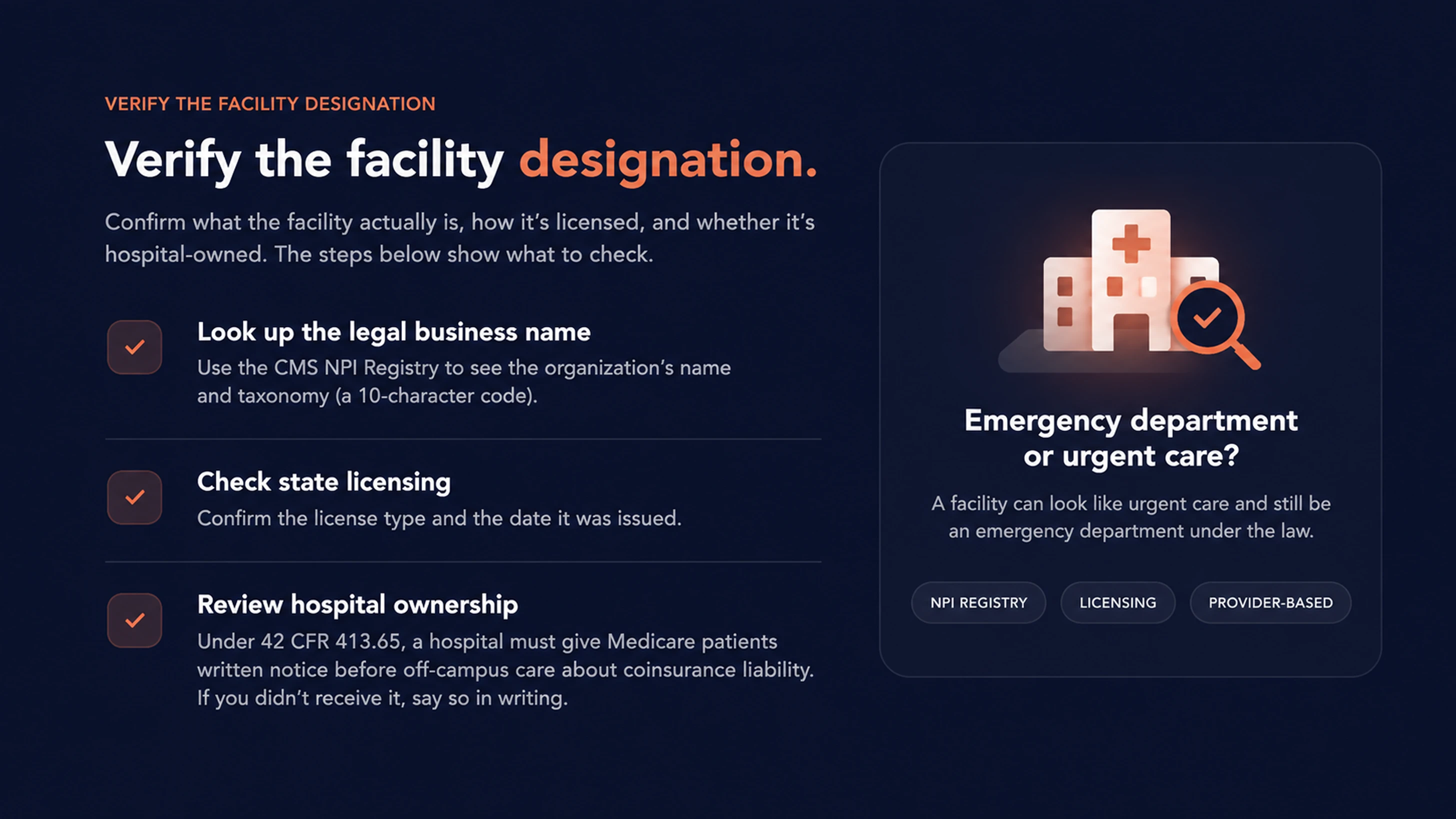
Now compare the official designation you verified with the location where you registered, then check what each claim submitted. A real conflict looks like urgent care billed as emergency room: a facility licensed only as urgent care with a claim coded as a hospital emergency room, or registration at one address and a claim listing another. Anything softer than that is a question.
Several things people treat as proof prove nothing on their own:
-
Your symptoms were minor. Emergency facilities bill by the resources used and the screening required.
-
The building looked like a clinic, or the sign was ambiguous.
-
A facility fee appeared on the statement. Hospital-owned outpatient departments bill facility charges by design.
-
The total was far higher than you expected. Price alone says nothing about the accuracy of the setting.
-
One code looked wrong to you. The medical claim place of service code and the facility claim can legitimately differ.
Cost still matters to the outcome even when the coding holds. Emergency physicians Kirstin Woody Scott and Amber Sabbatini argued in JAMA Network Open that "stronger limits on facility fees, particularly when services are equivalent with urgent care, could also reduce patient exposure to high costs," and their commentary accompanied findings that satellite freestanding emergency departments were associated with a $98 increase in median county medical debt in collections. A legitimate charge can still be negotiable.
Ask both parties
Call the provider's billing office and the insurer separately, because they hold different records. Keep the questions factual and short, and write down the answers with names and dates attached.
Ask the provider what department you were registered in on that date and which entities billed for this visit. Ask what type of bill and revenue codes went on the facility claim and what setting the professional claim reported. Ask the insurer which claims they received for this date and how they categorized each one. Ask which benefit rules they applied and what would change if the submitted setting changed. If the two accounts conflict, you have located the urgent care billed as emergency room problem precisely enough to act on it.
Not sure whether any of this applies to the statement in front of you? Upload it and get a free first look at the charges.
Document the resolution
If the billing is legitimate, ask for a written explanation naming the facility's designation and the benefit rules applied. If the records conflict, ask for a corrected claim and reprocessing, and get a reference number for that request. Pricing context helps here too, since hospitals must publish payer-specific negotiated charges in a machine-readable file under federal price transparency rules.
Track the case like a file. Log every call with a date and a name and keep the written responses as they arrive. Deadlines run while you wait, so note them early: most plans give you 180 days from a denial notice to file an internal appeal, and a written request for independent external review is due within 4 months of a final denial. If the visit involved an out-of-network emergency facility, the federal protections against balance billing limit your cost share to in-network levels. Documentation is what turns a suspected urgent care emergency room billing error into a corrected claim.
What to do next
Verification beats argument. Confirm the facility's designation and read the professional and facility claims on their own terms. Then ask the two parties the questions only they can answer. That sequence tells you whether you're looking at a correct charge or a correctable urgent care emergency room billing error.
mediloop reviews medical bills and EOBs with AI that extracts the charges and flags issues, and a human advocate reviews every case and handles supported provider conversations. If you have urgent care billed as emergency room charges in hand, upload a photo or PDF and check my bill for a free first look.